How to Insulate a Pole Barn: Insulation Options, R-Values & What You Need to Know
If you're building a new pole barn, garage, shop, agricultural building, or barndominium, insulation is one of those decisions that's worth thinking about early in the planning process.
If you just want to see the cost for insulation type plus labor, then click here to skip to that.
An uninsulated pole barn can be great for basic storage, but if you plan to heat or cool the building, work inside it year-round, protect temperature-sensitive equipment, or simply make the space more comfortable, proper insulation can make a big difference.
So, how do you insulate a pole barn? The answer depends on how you're going to use the building, your climate, your budget, and whether you're insulating the walls, ceiling, or both. There are several insulation options available for post-frame buildings, including fiberglass batts and rolls, spray foam, blown-in insulation, foam board, and reflective insulation. We'll give you a complete breakdown of each option and cover the most FAQs about insulating a post frame build.
Can You Insulate a Pole Barn?
Yes. Pole barns and garages can be insulated much like other buildings, and there are several insulation systems that work well with post-frame construction.
The best insulation method depends on the building's intended use. A simple storage barn may not need the same insulation package as a heated garage or workshop. A commercial building that needs consistent interior temperatures may have different requirements again.
For a conditioned building, insulation can help:
- Reduce heat loss during the winter
- Keep the building cooler during the summer
- Reduce drafts
- Improve energy efficiency
- Make the building more comfortable to work in
- Reduce condensation concerns
- Protect equipment, vehicles, materials, and stored items
- Make heating and cooling systems work more efficiently
The key is not simply choosing "the most insulation." It's choosing an insulation system that makes sense for the building.
What Is the Best Insulation for a Pole Barn?
There isn't one insulation type that's automatically best for every pole barn. Each has advantages and disadvantages depending on where it is being installed and what you're trying to accomplish.
Some of the most common options include:
- Blanket batts and rolls
- Spray foam
- Blown-in insulation
- Foam board
- Reflective insulation
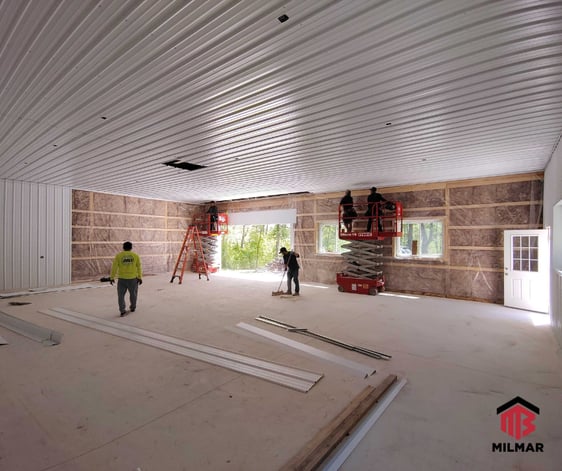
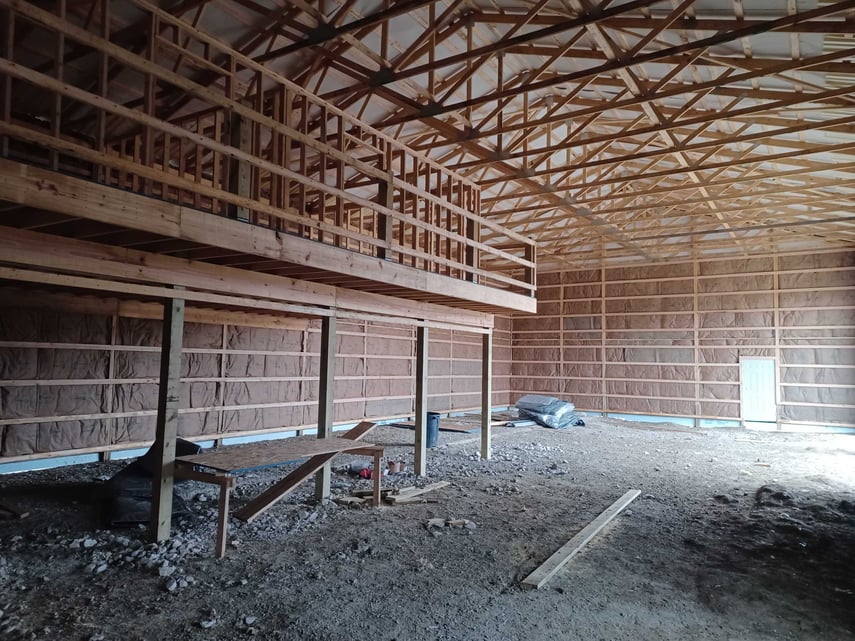 Build in progress that shows blanket batts/rolls installed between framing in a commercial post frame building.
1. Blanket Batts and Rolls
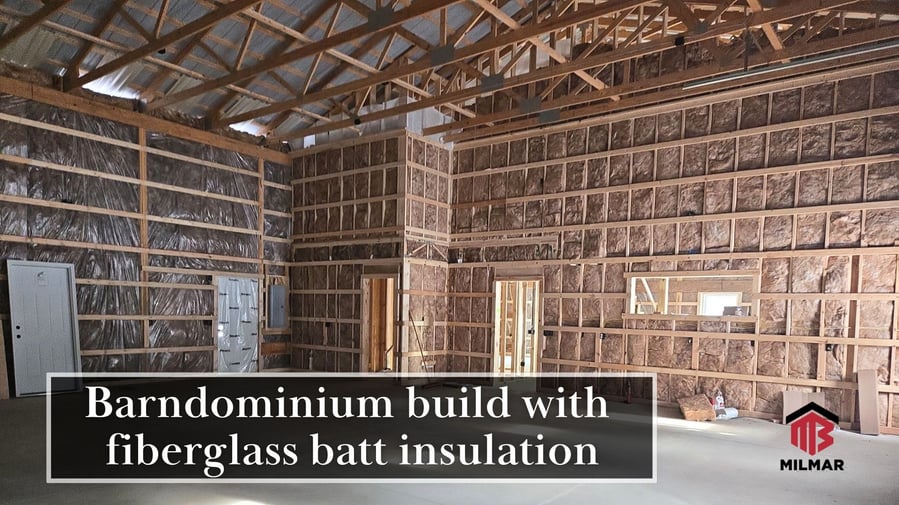
Fiberglass blanket insulation is one of the most common insulation options for pole barns. Batts and rolls are designed to fit between the framing and can be installed in walls and ceilings. They're also relatively affordable and are even a practical option for some DIY projects. Standard blanket insulation typically provides approximately R-2.9 to R-3.8 per inch, while higher-performance products can provide approximately R-3.7 to R-4.3 per inch.
Advantages of blanket insulation
- Relatively affordable
- Widely available
- Familiar installation method
- Works well in framed wall cavities
- Available in different thicknesses and R-values
- Can be used with different interior liner systems
Fiberglass does require proper safety precautions during installation. Gloves, long sleeves, eye protection, and appropriate respiratory protection should be used when working with fiberglass insulation.
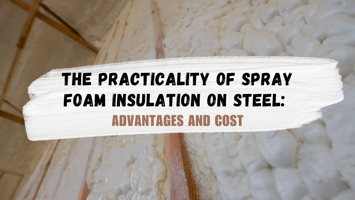
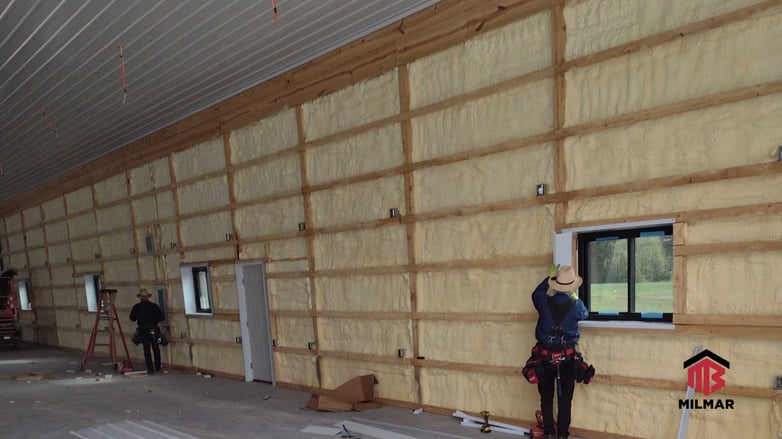 In progress build that shows spray foam insulation being installed on walls of post frame build.
2. Spray Foam Insulation
Spray foam is another option for insulating a pole barn, particularly when air sealing and filling gaps are important considerations. Spray foam is applied as a liquid and expands and hardens into an insulating material. Closed-cell spray foam generally has a higher R-value per inch than open-cell foam.
Milmar's insulation information lists approximately:
- Closed-cell spray foam: R-6.2 per inch
- Open-cell spray foam: R-3.7 per inch
One of the major advantages of spray foam is its ability to seal gaps and reduce air leakage. However, spray foam installation can be more complicated than installing fiberglass insulation. We recommend using a professional spray foam installer unless you have experience working with the material.
Can you spray foam directly onto the steel of a pole barn?
This is a question that comes up often. Spraying foam against steel can be done in some applications, but the building design and installation method matter. Temperature changes can cause metal siding to expand and contract, and improperly designed or installed foam systems can create problems with adhesion or condensation.
We recommend discussing the specific application with an experienced builder or insulation professional before deciding to spray foam directly against the steel panels.
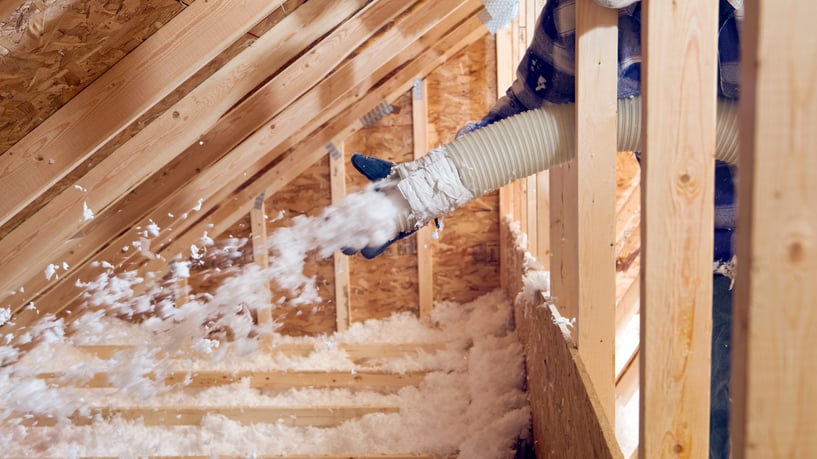 Blown-in Insulation
3. Blown-In Insulation
Blown-in insulation is another popular option for post-frame buildings, particularly for ceilings.
After the ceiling is installed, a machine blows fiberglass or cellulose insulation into the cavity. The material settles into the space and creates a thick layer of insulation that can fill gaps around framing. As we have mentioned in other articles on this blog, blown-in insulation is particularly well suited to flat ceilings in pole barns, where it can provide a relatively high R-value without the cost associated with some other insulation systems. It can also be used in wall cavities.
Blown-in insulation typically provides approximately R-2.2 to R-3.3 per inch, depending on the material.
Why use blown-in insulation in a pole barn ceiling?
It can be a good fit because:
- It can cover a large ceiling area efficiently
- It fills spaces around framing
- It works well with flat ceilings
- It can provide substantial insulation depth
- It can be a cost-effective option
It is also possible to rent blown-in insulation equipment for DIY projects, but the installation can be hot, dusty, and messy. And proper PPE is important!
4. Foam Board Insulation
Foam board is a rigid insulation product made from materials such as polyurethane, polystyrene, or polyisocyanurate. It can be used in several applications, including floors, low-slope roofs, foundation walls, basement walls, and ceilings.
Foam board we use is usually between R-4 to R-6.5 per inch, depending on the material. We use it most often for foundation walls, floors, and basement walls. One reason foam board is appealing is its relatively high R-value per inch. However, getting a high overall R-value may require multiple layers, so foam board is often used in combination with another insulation method.
5. Reflective Insulation
Reflective insulation is commonly used in pole barns and other metal buildings to help primarily address heat and condensation.
Rather than being measured in the same R-value terms as conventional insulation, reflective insulation works primarily by reflecting radiant heat and providing a layer between the metal and interior space. Materials can include foil, plastic, polyethylene bubbles, or similar products.
In a pole barn, reflective insulation can help:
- Reduce radiant heat transfer
- Reduce condensation dripping from metal
- Provide an additional weather barrier
- Create a dead-air space that can contribute to thermal efficiency
Reflective insulation is commonly used as a condensation and weather barrier in pole barns, similar in some respects to house wrap or plastic sheeting.
Important: Reflective insulation shouldn't automatically be viewed as a replacement for traditional insulation. It serves a different purpose and can be used as part of a larger insulation system.
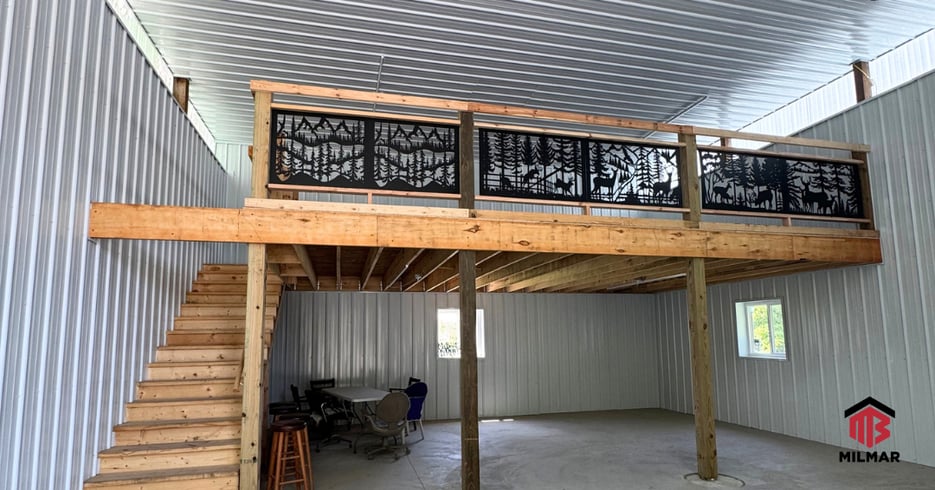
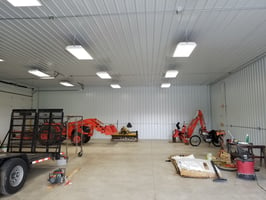
Detached garage barn with insulated walls and ceiling with metal liner.
What R-Value Do You Need for a Pole Barn?
R-value measures an insulation material's resistance to heat flow. Generally, a higher R-value means greater resistance to heat transfer.
The right R-value depends on several factors, including:
- Your climate
- Whether the building will be heated or cooled
- How the building will be used
- Where the insulation is being installed
- The overall building design
- Local building requirements
Milmar's insulation guidance recommends a minimum of approximately R-13 for walls and R-38 for ceilings.
For a Midwest pole barn, choosing an insulation system appropriate for the local climate is particularly important because buildings may need to deal with significant temperature swings throughout the year.
How Do You Insulate the Walls of a Pole Barn?
Pole barn walls are different from conventional stick-framed walls, so the insulation system needs to be designed around the post-frame construction. A common approach is to install blanket insulation within the wall cavity between the posts and framing.
At Milmar, one of the insulation systems commonly used for walls is 6-inch rolled insulation with an R-value of approximately R-19. The insulation is designed to span the space between posts and remain supported in the wall cavity rather than sagging over time.
We also use 24-inch rolls installed horizontally in some applications to make installation more efficient while maintaining the insulating performance.
The finished wall can then be left with exposed framing or finished with materials such as:
- Plywood
- OSB
- White ribbed metal
- A combination of interior liner materials
The right choice depends on how the building will be used and what kind of finished interior you're looking for.
How Do You Insulate the Ceiling of a Pole Barn?
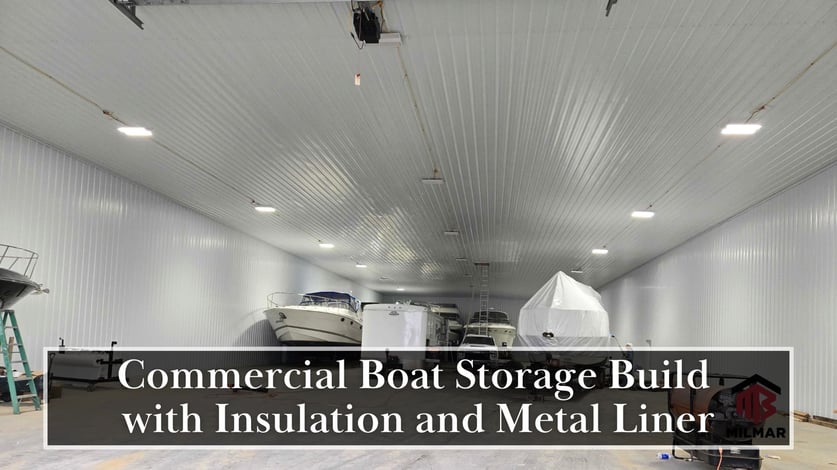
The ceiling is an important part of the insulation system because warm air naturally rises and a poorly insulated ceiling can allow substantial heat transfer. One common approach is to install an interior ceiling liner beneath the engineered trusses and then install blown-in insulation above it.
Milmar typically uses a white ribbed metal ceiling, OSB, or plywood, depending on the project, followed by blown-in cellulose insulation. And our typical ceiling insulation package provides approximately R-38. This creates a finished ceiling while providing a substantial layer of insulation above it.
Should You Insulate the Walls and Ceiling of a Pole Barn?
If you're planning to heat or cool your pole barn regularly, insulating both the walls and ceiling is generally the more complete and practical approach. Insulating only one portion of the building can leave other areas "leaking" the AC or heat. For example, a well-insulated wall system won't do much to improve overall efficiency if the ceiling is largely uninsulated.
For a heated garage, workshop, commercial building, barndominium, or other conditioned space, it's worth planning the entire insulation system before construction begins.
What Is the Best Insulation for a Heated Pole Barn?
For a heated pole barn, the best insulation depends on the building's design, heating requirements, budget, and desired interior finish. A combination of high-performance wall insulation and substantial ceiling insulation is often the best and most practical approach.
For example, Milmar's typical insulation package uses approximately:
- R-19 in the walls
- R-38 in the ceiling
The wall insulation can be paired with a finished interior liner, while blown-in cellulose is commonly used above the ceiling liner. This type of system can work well for buildings that need to be comfortable and usable year-round.
Does a Pole Barn Need a Vapor Barrier?
A vapor barrier or condensation-control layer is often an important part of a pole barn's building plan, particularly when you're dealing with a metal roof.
Metal panels can experience condensation when warm, moist air meets a colder metal surface. Depending on the building design, climate, and ventilation, this can lead to moisture dripping from the roof.
Reflective insulation or a properly designed vapor/condensation-control system can help address this concern. The exact assembly matters, though. A vapor barrier is not simply something that should be added anywhere without considering how the entire wall or roof system handles moisture. For that reason, it's smart to plan insulation, ventilation, and condensation control together.
Don't Forget About Air Sealing
Insulation isn't the only part of keeping a pole barn comfortable. Air leaks around doors, windows, wall transitions, roof penetrations, and other openings can allow conditioned air to escape and outside air to enter.
That's why a good insulation plan should also consider:
- Door and window openings
- Roof penetrations
- Wall transitions
- Ceiling connections
- Ridge areas
- Base of the building
- Other potential sources of drafts
Note: Milmar includes rodent guard with its pole barns. While rodent guard isn't insulation, it helps seal the bottom of the building, keeps rodents out, and helps block drafts around the base.
How Much Does It Cost to Insulate a Pole Barn?
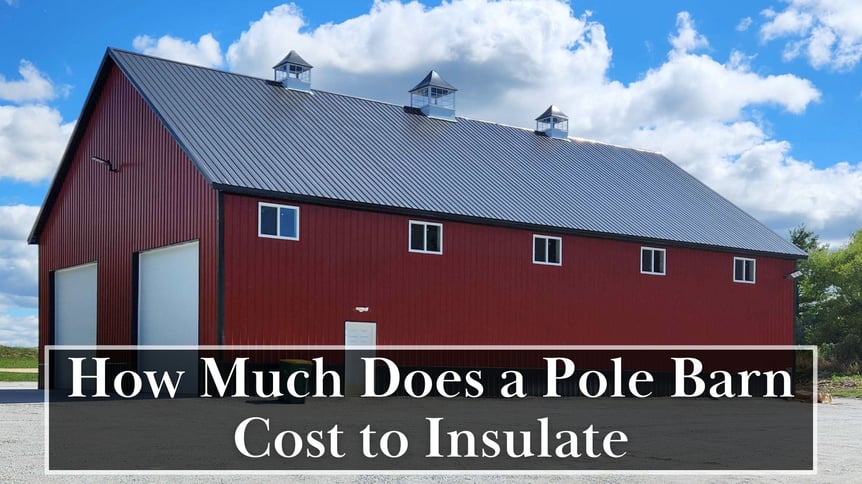
The cost to insulate a pole barn can vary significantly. There isn't one price per square foot that applies to every building because insulation costs depend on factors such as:
- Building size/Wall height
- Ceiling configuration
- Insulation type
- Desired R-value
- Interior liner material
- Number and size of doors and windows
- Whether the building will be heated or cooled
- Labor and material costs
- Whether the insulation is installed during construction or added later
A larger building isn't necessarily more expensive per square foot than a smaller building, either. The overall design and scope of the project can affect pricing.
If you already know you're going to heat or cool the building, planning insulation during the original design process is usually the better approach than trying to figure it out after the building is complete.
The average cost to insulate a pole barn or garage:
- Blanket batts and rolls (fiberglass batts) in walls at R-19 (with metal liner): $5.00/sq ft.
- Blown-in insulation in ceiling at R-38 (with metal liner): $5.00/sq ft
- Spray foam (for insulation only, installed on roof and walls, not including metal liner):
- 1.5" (R-9) Spray Foam Insulation - $3.50 / sq ft
- 2" (R-12) Spray Foam Insulation - $4.50 / sq ft
- 2.5" (R-15) Spray Foam Insulation - $5.50 / sq ft
- 3" (R-18) Spray Foam Insulation - $6.50 / sq ft
- 3.5" (R-21) Spray Foam Insulation - $7.50 / sq ft
- 4" (R-24) Spray Foam Insulation - $8.50 / sq ft.
- 4.5" (R-27) Spray Foam Insulation - $9.50 / sq ft
- 5" (R-30) Spray Foam Insulation - $10.50 / sq ft
- 5.5" (R-33) Spray Foam Insulation - $11.50 / sq ft
- 6" (R-36) Spray Foam Insulation - $12.50 / sq ft
Can You Insulate an Existing Pole Barn?
Yes, an existing pole barn can often be insulated. The best method depends on how the building was originally constructed and what interior finishes are already in place.
For an existing building, you may need to consider:
- Existing framing
- Roof and wall construction
- Existing condensation issues
- Electrical and mechanical systems
- Interior liner materials
- Available wall and ceiling cavity depth
- Moisture management
- Air sealing
Spray foam, blanket insulation, blown-in insulation, and rigid insulation may all be possibilities depending on the existing structure. However, adding insulation to an existing pole barn isn't simply a matter of filling every available space with insulation. The entire assembly should be considered so that you don't accidentally create moisture or condensation problems.
Which Pole Barn Insulation Should You Choose?
The right choice ultimately comes down to what you're asking your building to do.
If you're building a basic storage barn:
You may not need a full insulation package, depending on your year-round use.
If you're building a garage or workshop:
Wall and ceiling insulation can make the building much more comfortable, particularly if you're planning to heat it. And if you plan to heat the build, having insulation will of course make the build more economical in the long run.
If you're building a year-round conditioned space:
You'll want to put more thought into the entire building envelope, including insulation, air sealing, condensation control, and the HVAC system.
If you're building a commercial or agricultural building:
Your insulation needs will depend heavily on the building's use and whether temperature control is necessary. Feel free to contact our team to ask about your specific use-case and what they would recommend.
If you're building a barndominium:
Insulation becomes an even bigger consideration because the building is functioning as a home. Your insulation, air sealing, vapor control, windows, doors, HVAC system, and other components should all be designed carefully.
Milmar's Typical "Complete" Insulation Package
For customers looking for a more complete insulation system, Milmar commonly uses a combination of wall and ceiling insulation.
Walls:
Approximately R-19 using 6-inch rolled insulation, with other roll configurations available depending on the project.
Ceiling:
Approximately R-38 using blown-in cellulose above a finished interior ceiling.
Interior liner:
White ribbed metal, OSB, plywood, or combinations depending on the building and owner's needs.
Rodent guard:
Included with Milmar buildings to help seal the bottom of the structure and reduce drafts and rodent entry.
Milmar also offers custom insulation and liner options, so the insulation package can be tailored to the building rather than treating every pole barn exactly the same.
Frequently Asked Questions About Pole Barn Insulation
What is the best way to insulate a pole barn?
The best way to insulate a pole barn depends on its intended use, climate, budget, and building design. Common options include fiberglass blanket insulation, spray foam, blown-in insulation, foam board, and reflective insulation. For a heated or cooled building, insulating both the walls and ceiling is typically an important part of creating an efficient building envelope.
What R-value should a pole barn have?
The appropriate R-value depends on the building and local climate. We recommend approximately R-13 minimum for walls and R-38 for ceilings as a general guideline. Local building requirements and the building's intended use should also be considered.
Is fiberglass insulation good for a pole barn?
Yes. Fiberglass blanket insulation is a common and relatively affordable option for pole barn walls and can work well within post-frame wall cavities. We commonly use R-19 rolled insulation in our wall insulation packages.
Is spray foam good for a pole barn?
Spray foam can be an effective insulation and air-sealing option for a pole barn. Closed-cell foam provides a higher R-value per inch than open-cell foam, but spray foam installation can be more expensive and requires careful application, particularly when used direclty against metal siding or roofing.
Is it worth insulating a pole barn?
If you plan to heat, cool, work in, or regularly occupy your pole barn, insulation can be well worth considering. It can improve comfort, reduce drafts, help control heat transfer, and make heating and cooling more efficient.
Can you insulate a pole barn after it is built?
Yes, many existing pole barns can be insulated after construction. However, the existing wall and roof assemblies, moisture control, framing, interior finishes, and available space all need to be considered before choosing an insulation method.
Should I insulate the walls or ceiling of my pole barn?
If the building will be heated or cooled, insulating both is generally the better approach. The walls and ceiling are both part of the building shell, and leaving one largely uninsulated can reduce the overall effectiveness of the system.
Does reflective insulation stop condensation in a pole barn?
Reflective insulation can help reduce condensation on metal surfaces by providing a separation layer and helping manage radiant heat and moisture. However, condensation control depends on the entire building assembly, including ventilation, air sealing, insulation, and moisture management.
Can you spray foam directly onto pole barn metal?
It can be possible, but the specific building assembly and installation method matter. Metal expands and contracts with temperature changes, and improperly designed or installed spray foam systems can create problems. This is an application where consulting with an experienced builder or insulation professional is recommended.
Planning a Pole Barn? Think About Insulation Before You Build
One of the biggest mistakes you can make with a new pole barn is treating insulation as an afterthought. If you know from the beginning that your building will eventually become a heated garage, workshop, commercial space, agricultural building, or year-round living space, tell your builder during the design process. That gives you the opportunity to plan the framing, ceiling, interior liner, doors, windows, ventilation, electrical, and insulation as one system.
We offer custom insulation and interior liner options for pole barns, garages, agricultural buildings, commercial buildings, equestrian buildings, and other post-frame construction.
Planning a new pole barn or post-frame building? Talk with our building rep team about insulation options and design your building around how you actually plan to use it.
Check out these linked topics to learn more about pole barn and garage designs, pole barn and garage building terms, and our last insulation options article.